
The following essay was written by Arja Singh, a student in Frisco ISD, class of 2026.
Most days after school, I get in my car, plug in my phone, and start my favorite political streamer almost reflexively. It’s my way of staying up to date on the whirlwind of national and international headlines, from Supreme Court decisions to student protests across the world. To me, civic engagement has always looked like rallies in Washington, interviews on cable news, and hashtags trending worldwide.
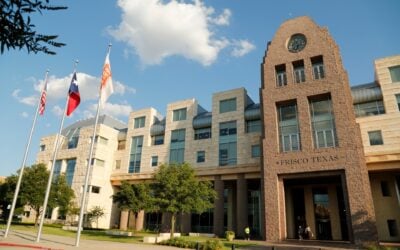
But on a recent spring afternoon, I traded the noise of the 24 hour news-cycle for the quiet hum of Frisco City Hall.
As I walked up the steps, I wondered what civic engagement looks like closer to home, where decisions about schools, safety, and neighborhoods are made, and how I, a mere high school student, could play a role.
That curiosity brought me to a conversation with the city’s mayor, who has led Frisco’s transformation for almost two decades, despite never seeing himself as a particularly “political” person in the conventional sense. What I found was a story not driven by ideology, but about investment, a story about how quiet involvement can lead to lasting change, and what that means for students like me.
When I sat down with the Mayor, a man whose name I had heard of like an urban legend since I have lived in Frisco, what stuck me beyond his outwardly warm personality was how much his journey into public service started with something deeply personal: wanting to build a better community for his young family. “Honestly, I just wanted to build a better community for my kids,” he told me. “That’s what got me started.”
The Mayor laughed when I asked about his early political interests, recalling how his first foray into civic leadership was hardly ideological or partisan: he ran for eighth-grade student council president to change the school’s toilet paper. “Our issue-driven mandate was, we needed to get changes made to our toilet paper in our bathroom,” he said, laughing. “And so we created quite the stir… and they did change it.”
But even though that middle school mission was lighthearted, his answer revealed something deeper. He didn’t grow up politically active, nor did he see himself as an activist in college. In fact, he described himself while at university as “more on the indifferent side.” His eventual decision to serve in public office came not from party politics, but from a sincere desire to create a better future for his three young children, and that intention remains at the heart of how he governs.
That personal approach is reflected in how Frisco engages young people today. The Mayor highlighted the Mayor’s Youth Council, an initiative that selects dozens of high schoolers each year to learn about city government and advise local leaders. “We usually select between 40 and 50 kids to be part of it, but we’ll get several hundred applications,” he noted. “It helps us see the city through the lens of teenagers.. and sometimes it’s really eye-opening.”
Frisco teens have shown up to city council meetings to speak on local issues, he said, a sign of growing student confidence. He attributes some of that momentum to how competitive and high-achieving local students have become. “I was a great student, fifth in my class of nearly a thousand, but I look at students today and it’s like, everyone’s started a nonprofit.”
Yet when it comes to political expression, especially protest, his views are more measured. He affirmed students’ First Amendment rights but questioned how effective protest really is at creating change. “I don’t know that I see it accomplishing anything other than just continuing to drive that wedge,” he said, lamenting the polarization he sees between the political extremes. Instead, he emphasized the importance of dialogue, listening, and finding common ground, even with those we disagree with. “You may never agree, but you can at least understand the perspective the other person’s coming from.”
As someone used to hearing arguments from all sides, he sees his role as mayor not through a partisan lens but as a responsibility to “represent all 250,000 people that live here.” To him, that means building trust with students and residents of every background, not just those who are already civically active. “Sometimes, we can’t draw people out. We need people to raise their hands.” But when they do, the city has taken steps to meet them halfway, from community conversations across cultural groups to ongoing efforts to create more volunteer and internship opportunities within Frisco itself.
Before our conversation ended, I asked him what advice he’d give to students like me, young people with opinions and passion, but not always having a clear roadmap for making change. He paused for a moment before saying: “Figure out what the issue is. Ask questions. Be curious. And don’t be afraid to challenge how things are done. You’ve got to peel back the layers and understand it.”
At that moment, I realized something. Civic engagement isn’t just about making noise, it’s about paying attention, showing up, and asking better questions. And in Frisco, at least, we have a mayor who’s willing to listen.


